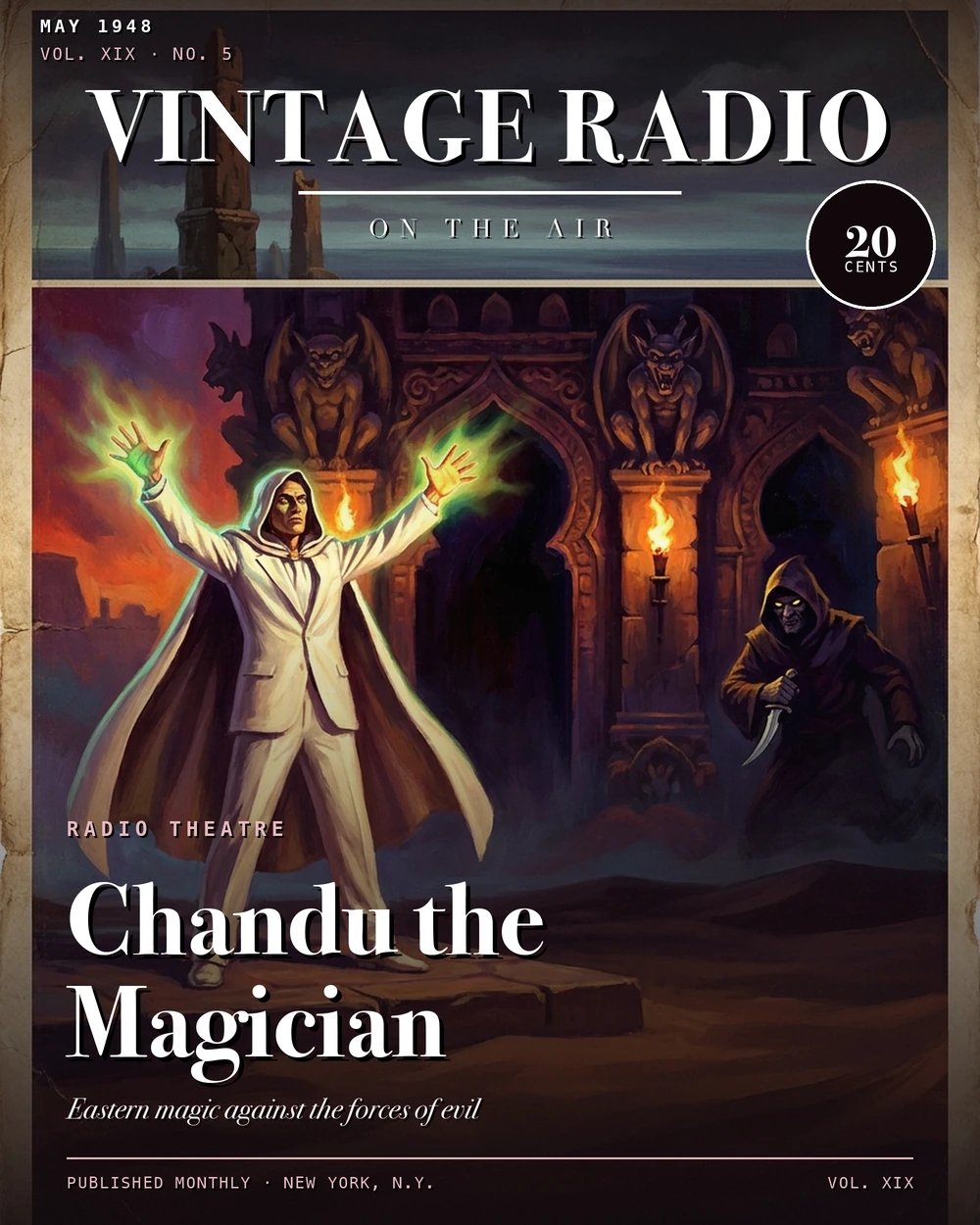
Chandu the Magician
How It Came Together
The idea behind Chandu the Magician was simple and well-timed. In 1931, partners Raymond R. Morgan and Harry A. Earnshaw were brainstorming show concepts when Earnshaw brought up the public's high interest in magic. From that conversation came Frank Chandler — an American-born mystic who had learned the secrets of the East from a yogi in India and taken the name Chandu. The character's purpose was equally clear: to fight the world's evil forces using occult powers and a far-reaching crystal ball.
The name itself raised eyebrows. In 1932, Walter Winchell took a column-inch to point out that "one of the smaller radio chains has a feature called Chandu, which is Hindu-Chinese for an opium preparation. In fewer words — dope." Chandu was indeed slang for a kind of smokeable opium, though the show's listeners seem not to have been bothered by the etymology.
The show first aired on KHJ in Los Angeles on October 10, 1932, and spread quickly. It moved onto the Don Lee Network, a California chain that eventually reached into the Northwest, and a Mutual Network line was added in the mid-1930s, pushing coverage as far east as St. Louis. Transcription records were also marketed independently in areas not served by the networks, giving the serial a broader footprint than any single chain could have managed. White King Soap sponsored it in the West; Beech Nut Gum picked up the East.
The Story It Told
The original 1932–35 run was built around a single extended plot: the search for Robert Regent, the husband of Chandler's sister Dorothy. Robert had vanished in a shipwreck ten years before the story began, but Chandler's occult powers suggested he might still be alive, held prisoner somewhere by Roxor — a master criminal with ambitions to rule the world. The first 68 chapters played out largely in Egypt, with subplots spiraling outward from there.
Those subplots included a quiet romance between Chandler and Nadji, an Egyptian princess, and a more turbulent one between Dorothy's daughter Betty and a Bedouin beggar. The serial took listeners to Monrovia and Algiers, and to invented locations like the gypsy camp in "Montabania" and the lost continent of "Lemuria." Roxor was the thread running through all of it — a villain driven by world domination who gave the serial its spine across both its original run and its later revival.
One of the show's more unusual dramatic devices was Chandler's central weakness: his magic was impotent in the face of blind fear. Dorothy's mounting terror wasn't just an emotional subplot — it could render Chandu helpless at the worst possible moment. That vulnerability gave the serial real tension underneath all the exotic atmosphere.
The People Who Made It
Writer Vera Oldham started at the production as an office girl who tried out as a writer and turned out to be essential. She wrote the scripts for the full original 1932–35 run and became so valuable to the serial that the agency handling the account rewarded her — one year with an Oriental vacation, and a new Studebaker waiting for her when she returned. After the original serial ended, Oldham moved on to write for the Maxwell House Show Boat, Those Websters, and other programs.
Director Cyril Armbrister and musician Felix Mills (later replaced by Raymond Paige) rounded out the original production team. In the original cast, Gayne Whitman played Chandu, with Margaret MacDonald as Dorothy Regent, Bob Bixby as her son Bob, and Betty Webb as her daughter Betty. Whitman — born Alfred Vosburgh in Chicago in 1890 — had appeared in more than 200 films by the end of his career, and changed his screen name partly because, as he put it, "1917 was not a good time to have a German sounding name."
When production shifted to WGN in Chicago around 1935–36, the cast changed entirely: Howard Hoffman took over as Chandu, Cornelia Osgood played Dorothy, Olan Soule played Bob, and Audrey McGrath played Betty Lou. The Chicago run was transcribed at the World Broadcasting System's local facilities for distribution to other stations, including WJR in Detroit, which was carrying it by April 1935.
The Revival Twelve Years Later
What makes Chandu the Magician unusual in old-time radio history is what happened after the original run ended. Roughly twelve years of silence passed before Raymond Morgan and his collaborators, brainstorming for a new serial, landed on the idea of reviving Chandu and reassembling the original crew.
Armbrister was in New York by then, with credits that included Land of the Lost and Terry and the Pirates. Morgan brought him back to California to direct. Oldham was reactivated to do a light rewrite of the original scripts — the goal was a more modern, faster-moving feel without abandoning what had worked. When the revived show was sold, the same executive who had bought it for White King Soap the first time bought it again. Even the original gong that had introduced the serial was resurrected. The revival began, like the original, with the search for Robert Regent.
The revived serial ran on Mutual-Don Lee from June 28, 1948, as a 15-minute weekday continuation sponsored by White King Soap, then shifted in February 1949 to a 30-minute Thursday format with self-contained episodes. In October 1949 it moved to ABC — this time sponsored by United States Savings Bonds rather than a commercial product — running Saturdays at 7:30 through June 10, 1950, then switching to Wednesdays at 9:30. The final broadcast was September 6, 1950.
The Cast and Sound of the Revival
The 1948–50 run brought in Tom Collins as Chandu, Irene Tedrow as Dorothy, Lee Millar as Bob, and Joy Terry as Betty. Veola Vonn played Princess Nadji, Chandler's love interest, and Luis Van Rooten took on Roxor — still the master criminal with global ambitions. Howard Culver served as announcer. Van Rooten was an unusual hire: a former practicing architect who had switched to acting, fluent in French, Italian, and Spanish, and so in demand that his New York Times obituary later noted he had worked on as many as 50 shows a month at his peak. He would go on to voice both the King and the Grand Duke in Walt Disney's Cinderella the same year Chandu left the air.
The organ music in the revival was provided by Juan Rolando, who took air credit under his Hindu name, Korla Pandit. The story behind that credit is among the more remarkable in radio: the organist was in fact John Roland Redd, an African American musician from St. Louis who had passed as Mexican to gain entry to a Musicians' Union closed to Black members, and whose transformation into the Brahmin Indian persona of Korla Pandit effectively began with the Chandu revival on June 28, 1948. Pandit used Felix Mills' original Chandu theme, later renaming it Trance Dance and claiming authorship. His exposure on the show led directly to Korla Pandit's Adventures in Music on KTLA in February 1949 — the first all-music program on television.
The signature opening remained what it had always been: the gong, then a deep-voiced announcement — "CHANNNNDOOOO ...the Magician!" — before the story began. For listeners who remembered the original, that gong and that announcement would have been immediately recognizable after more than a decade away.
Beyond Radio
Chandu's reach extended well past the broadcasts. Fox Film Corporation released a 1932 feature, Chandu the Magician, co-directed by William Cameron Menzies and Marcel Varnel, with cinematography by the legendary James Wong Howe. Edmund Lowe played Chandler, Irene Ware was Princess Nadji, and Bela Lugosi — in one of his definitive villain turns — played Roxor, kidnapper of a scientist who has built a death ray capable of reaching halfway around the world. The film was successful enough to spawn two sequels, The Return of Chandu (1934) and Chandu on the Magic Island (1935), both starring Lugosi — this time in the heroic lead, a striking reversal from his earlier role. Director Cyril Armbrister even turned up in The Return of Chandu in a cameo as a henchman called Sutra.
The character's longer legacy ran through the comics. Chandu is widely cited as a direct inspiration for Marvel's Doctor Strange, the Steve Ditko and Stan Lee creation, and as a likely influence on Lee Falk's Mandrake the Magician, whose hypnotic powers closely echoed Chandler's own. The serial arrived at the front edge of a wave of popular interest in stage magic and the occult that also produced The Shadow on radio — placing Chandu, in the words of the St. James Encyclopedia of Popular Culture, alongside the defining mystical characters of the era.